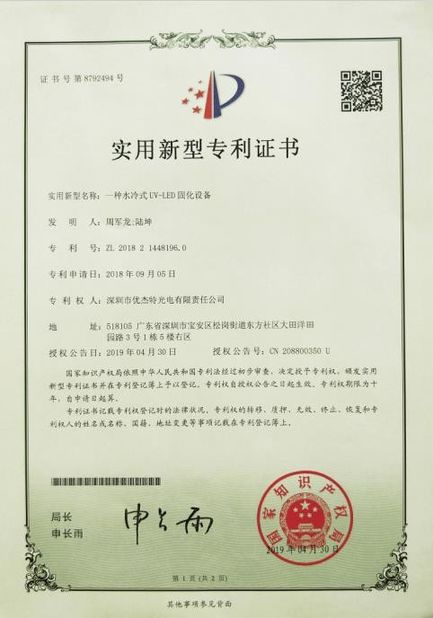
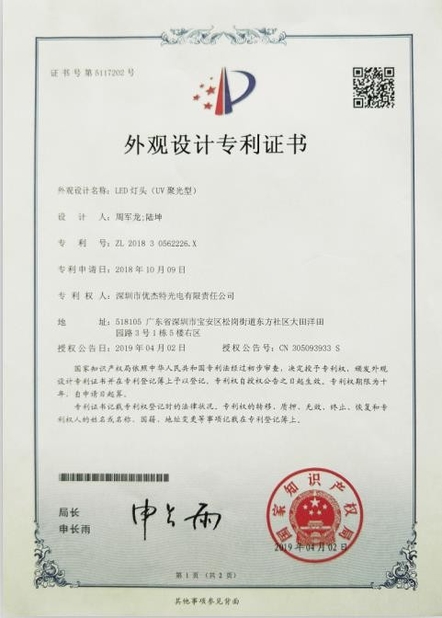
As optoelectronic display devices rapidly evolve toward ultra-thin designs, narrow bezels and higher integration, process requirements for precision packaging and structural bonding in LCD panels and backlight modules have undergone a comprehensive upgrade. Recently, a leading ultraviolet (UV) curing technology provider officially launched an integrated automated bonding and UV-LED light source curing solution tailored for the full series of optoelectronic display UV adhesives, including 3789/3789L, 3761, 3791, 3768, 3730 and 3721. This solution addresses core production bottlenecks across the entire workflow, from large structural component fixing to micrometer-level thin-layer packaging.
Precision Matching Across Full-Series Applications Builds a High-Reliability Curing Foundation
In optoelectronic display manufacturing, distinct bonding scenarios impose multi-dimensional demands on adhesive performance and curing light sources:
- Large Backplate Structural Component Fixing (3789/3789L Galvanized Sheet Fixing Adhesive): High-power UV-LED area/line light sources (395nm/365nm) achieve deep curing in seconds with bonding strengths exceeding 12 MPa, while the cold light source prevents thermal distortion of metal and plastic components.
- Display Module COG/ITO Bonding Area Insulation & Anti-Corrosion (3761 Protective Coating Adhesive): Paired with a high-precision UV-LED fiber spot light system, the spot adjusts precisely from 1 mm to 5 mm and cross-links within 1–2 seconds into a dense insulation layer that passes rigorous Dual 85 (85°C / 85% RH) reliability tests.
- Liquid Crystal Injection Port Leak-Proof Sealing (3791 Sealing Adhesive): A water-cooled, high-uniformity (>95%) UV-LED curing system keeps the target-area temperature rise within 3°C, preventing heat from disturbing liquid crystal molecules and achieving 100% contamination-free sealing.
- Flexible Screen & FPC Bonding Point Protection (3768 Reinforcement Protective Adhesive): Smart-Cure multi-stage intelligent energy control technology applies graduated output of pre-curing positioning plus main curing cross-linking, enabling reinforcement points to withstand over 100,000 dynamic bending cycles without cracking.
- Backlight Lens & Strip High-Efficiency Bonding (3730 Transparent Silicone Fixing Adhesive): Engineered for high-viscosity (40,000 mPa·s) silicone adhesives, in-line continuous UV-LED conveyor belt curing tunnels deliver high irradiance to reach the 1200 mJ/cm² curing threshold instantly, ensuring zero lens displacement and light transmittance above 99%.
- Ultra-Thin Module Micro-Protection (3721 Thin-Layer Packaging Protective Adhesive): A fanless water-cooling design eliminates vibration ripples, creating an ultra-thin moisture barrier with micrometer-level flatness, ideal for chip thin-layer encapsulation in OLEDs and wearable devices.
Technical Empowerment: Three Core Advantages of Automated UV-LED Curing
Compared with traditional medium-pressure mercury lamps, this automated UV-LED curing solution delivers significant technological advantages on display assembly lines:
- Ultra-Low Thermal Radiation: Substrate temperature rise is kept below 5°C, resolving thermal deformation issues in heat-sensitive optical components and films.
- Pure and Efficient Wavelength Output: Pure narrow spectrums at 365nm, 385nm and 395nm eliminate yellowing risks caused by stray light, achieving high-strength cross-linking in seconds.
- High Automation Integration: Zero preheating and millisecond-level switching enable seamless integration with PLC setups and industrial robots, supporting frictionless automated conveyor operations while cutting energy consumption by over 70%.
Comparison: Automated UV-LED Curing vs Traditional Mercury Lamps
| Feature | Traditional Mercury Lamps | Automated UV-LED Curing Systems |
|---|
| Thermal Radiation | Substrate heats up 60–90°C | Temperature rise below 5°C |
| Wavelength | Broad spectrum with stray light | Pure 365/385/395nm narrow spectrums |
| Start-up | Preheating required | Zero preheating, millisecond switching |
| Energy Consumption | High power consumption | Saves over 70% energy |
Driving Industry Synergy and Upgrades
The rollout of this comprehensive automated bonding and UV curing solution marks the further maturation of materials-plus-equipment synergy in display manufacturing. By providing clients with free sample testing, spectral matching evaluations and custom curing module development, this integrated approach significantly shortens product development cycles, improves overall yield rates and empowers the next generation of high-precision display manufacturing.

 Your message must be between 20-3,000 characters!
 English