Not Curing Deep Enough? The Exact Math Behind Matching UV LED Irradiance and Curing Time
When a UV adhesive, resin, or ink looks completely dry on the surface but remains liquid or tacky underneath, it triggers delamination, structural failure, and costly product recalls.
As a UV LED curing lamp manufacturer, we frequently see factories trying to fix depth issues by simply extending curing time or blasting the substrate with excessive power. However, deep cross-linking follows a strict scientific law. Here is the engineering guide to matching UV LED irradiance (light intensity) and curing time to achieve perfect depth of cure.
The Core Science: Why Surface Curing ≠ Deep Curing
To understand why depth fails, we must look at how ultraviolet light penetrates polymers.
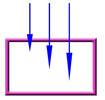
As UV photons travel downward into a layer of liquid resin, they are continuously absorbed by photoinitiators, pigments, and the polymer matrix itself. This natural phenomenon is governed by the Beer-Lambert Law, which dictates that UV light intensity decays exponentially as it penetrates deeper into a material.
[UV LED Light Source]
        │
        ▼ (High Intensity)
┌───────────────────┐  ◄─── Surface: Instantly Cured (High Photon Density)
│    Top Layer      │
├───────────────────┤  ◄─── Middle: Requires Correct Wavelength & Irradiance
│   Bottom Layer    │
└───────────────────┘  ◄─── Depth: Vulnerable to Under-Curing (Light Decay)
If your UV LED system's peak intensity is too low, the photons will be entirely consumed at the surface, leaving the base completely uncured—no matter how many minutes you extend the exposure time. Time cannot compensate for a lack of foundational intensity.
The Balancing Act: Irradiance vs. Radiant Energy (Dose)
To optimize your production line, your engineering team must balance two distinct metrics:
-
Irradiance (W/cm²): The intensity of the light striking a given area. High intensity is required to punch through thick or heavily pigmented layers.
-
Radiant Energy / Dose (J/cm²): The total accumulated energy over time (Dose = Irradiance * Time).
The Failure Loop of Mismatched Factors:
-
Scenario A: High Intensity + Too Short Time. The surface cures instantly, forming an optical barrier or skin that traps uncured liquid underneath.
-
Scenario B: Low Intensity + Extremely Long Time. The energy dose looks correct on paper, but the light never reaches the bottom layer. The adhesive fails adhesion and cross-hatch tests.
The Matching Law for Deep-Layer Solidification
To achieve maximum depth of cure without overheating sensitive substrates, follow these factory-tested optimization rules:
1. Leverage Multi-Wavelength Spectrum Strategy
For ultra-thick coatings (>2mm) or opaque resins, standard 365nm wavelengths might struggle. Shorter wavelengths (like 365nm) are highly effective for crisp surface curing, while longer wavelengths (like 395nm or 405nm) penetrate much deeper into the material due to lower absorption coefficients. Custom dual-wavelength UV LED arrays provide the perfect top-to-bottom cure profile.
2. Establish the Irradiance Threshold First
Before adjusting your conveyor belt speed or cycle timers, determine the minimum Irradiance Threshold required for your specific resin thickness. Increase the UV lamp's power output until the light successfully pierces the bottom layer, and then adjust the time (or conveyor speed) to deliver the total required energy dose (J/cm²).
3. Implement Intelligent Step-Curing
For highly delicate electronics packaging, a single high-intensity blast can cause shrinkage or stress fractures. Advanced production lines utilize Step-Curing: a low-intensity pre-cure phase to initiate uniform gelation throughout the depth, followed instantly by a high-intensity pulse to fully cross-link the polymer structure.
Engineering Standards: Benchmarking Deep Curing Systems
| Manufacturing Challenge |
Material Thickness |
Recommended Wavelength |
Required Peak Irradiance |
| SMT Red Glue Curing |
Thin (0.1 - 0.5mm) |
365nm / 395nm |
2.5 - 4.0 W/cm² |
| Electronic Potting / Encapsulation |
Thick (1.0 - 3.0mm) |
395nm + 405nm Hybrid |
8.0 - 12.0 W/cm² |
| Optical Glass Bonding |
Medium (0.5 - 1.5mm) |
365nm |
4.0 - 6.5 W/cm² |
Upgrade Your Factory's Curing Precision Today
Stop relying on guesswork and eliminating defects by trial-and-error. As an industrial-grade UV LED curing lamp manufacturer, we specialize in customizing optical designs, reflector configurations, and water-cooled architectures that deliver stable, high-intensity UV output tailored for deeper penetration.
Our systems feature real-time digital controller integration (PLC) to ensure that your irradiance-to-time ratio remains perfectly consistent across millions of cycles, fully compliant with global IPC and ISO manufacturing standards.
Eliminate under-curing defects on your line. [Contact Our Engineering Consultation Team] today. Send us your resin specifications or substrate samples, and our lab will calculate the exact irradiance and time matching profile for your factory.

 Your message must be between 20-3,000 characters!
 English